
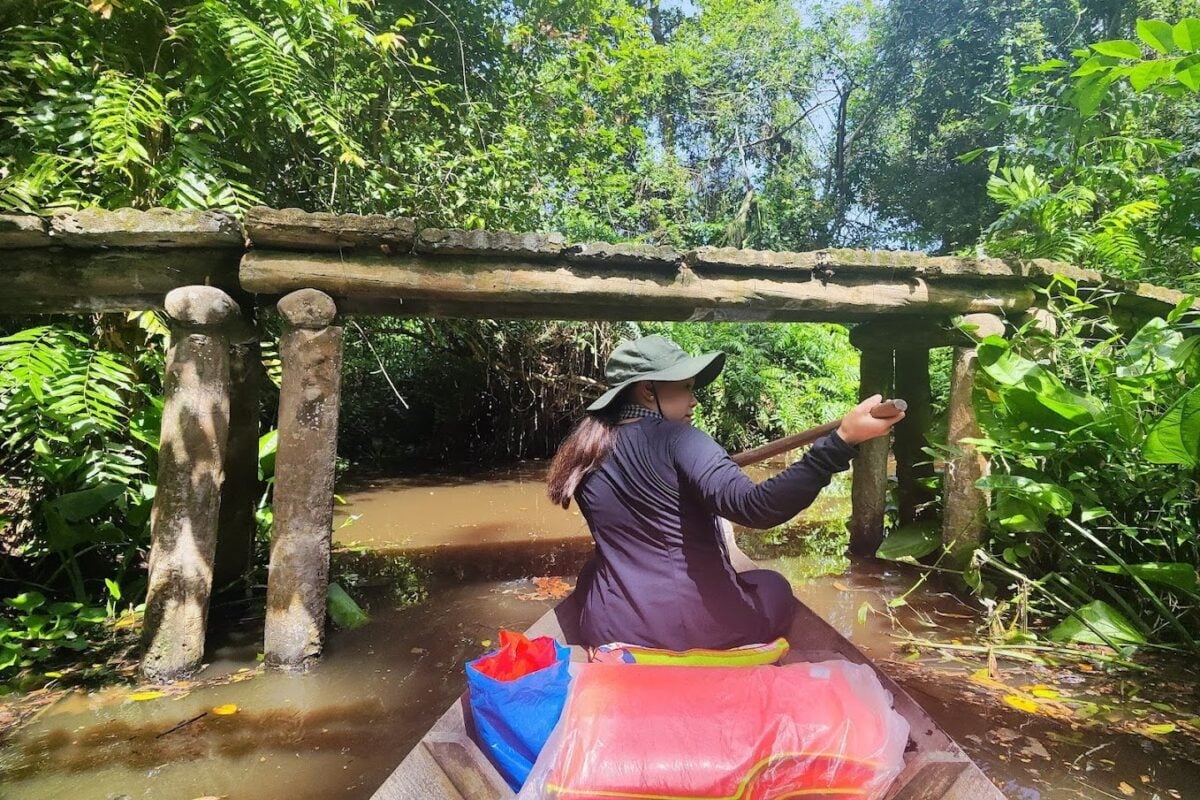
The Mekong Delta sits at the southernmost part of Vietnam, where the Mekong River divides into a network of rivers and canals before meeting the sea. These waterways have shaped the land into one of the country’s most fertile regions, producing more than half of Vietnam’s rice along with tropical fruits, freshwater fish, and flowers.
But what truly sets the Mekong Delta apart is its layered cultural identity. Generations of Vietnamese settlers live alongside Khmer, Chinese, and Cham communities, each contributing to the region’s beliefs, food, and festivals. The result is a local character shaped by cooperation, hospitality, and adaptability. People here often describe this spirit as hào sảng, which is a kind of openhearted generosity that defines both how they live and how they welcome visitors. For many, growing up here means knowing every neighbor, eating dinners across open fences, and greeting strangers like old friends.
The Mekong Delta’s watery landscape and rich cultural heritage makes it a unique destination and one that might just be a highlight of your trip to Vietnam.
Mekong Delta Map and Resources
More info: (opens in new tab)
- 🇻🇳 Vietnam Travel Guide
- 💲Cost of Backpacking in Vietnam
- 📍Nearby places: Ho Chi Minh City | Phu Quoc | Phnom Penh
- 🚲Must do activity: Mekong Delta Bike Tour
A Complete Guide to the Mekong Delta, Vietnam 🎒
Best Time to Visit the Mekong Delta, Vietnam 🌦️
The Mekong Delta can be visited year-round, but each season offers a different pace and atmosphere. Choosing the right time depends on what kind of experience you are looking for.
From December to April, the region enters the dry season. This is considered the most comfortable time to visit, with cooler air, blue skies, and little rain. Boat trips, cycling, and long countryside walks are all easier to enjoy. Around Tet (Vietnamese Lunar New Year), flower villages like Sa Đéc (Đồng Tháp) come into full bloom, markets are lively, and communities prepare special meals for the holiday.
Between May and August, short daily rains begin to return, refreshing the land and cooling the afternoons. This is also fruit season, when orchards in Ben Tre, Vinh Long, and Can Tho are filled with ripe rambutan, mangosteen, durian, and longan. Early mornings are perfect for market visits or orchard tours, while afternoons may bring passing showers.
From September to November, the Mekong enters its flood season, especially in lowland areas like Dong Thap and An Giang. The rising water turns fields into shimmering lakes, and locals paddle between homes, schools, and lotus ponds. Bird sanctuaries and wetlands like Tram Chim National Park or Tra Su Cajuput Forest are at their most vibrant during this period. Far from being disruptive, the floods are a natural part of life here and offer some of the region’s most memorable scenery.
However, travelers should also be aware of the saltwater intrusion period, which usually occurs between late February and April in coastal provinces like Ben Tre, Tra Vinh, and Ca Mau. During this time, seawater flows upstream and mixes with the freshwater systems. While this does not affect major tourist sites, it may limit agricultural activities and freshwater availability in some homestays or villages. If you plan to stay in more remote areas or join farm-based experiences, it’s best to check with your host in advance to avoid surprises.

Where to Stay in the Mekong Delta, Vietnam 🛌🏽
You have two main choices when it comes to staying in the Mekong Delta: a countryside homestay or a hotel in one of the region’s towns and cities. There are some hostels in the larger towns, such as Can Tho, but you are less likely to find these in the smaller towns and villages.
Most provincial cities now offer a wide range of hotels and guesthouses, with reliable comfort and modern amenities. If you’re looking for convenience, strong Wi-Fi, or easy access to restaurants and transport, this option makes perfect sense.
That said, I recommend staying at a homestay if you want to really feel the countryside atmosphere and understand the spirit of the Mekong Delta. These family-run places may be more basic, but they offer a closer connection to local life, food, and nature. Some homestays include activities like cooking classes, guided walks, short boat rides, or visits to nearby craft villages.
Here are a few homestays I’ve stayed at and would happily return to. If you visit these areas, they’re worth considering:
- The Mango Trail Farms in Đồng Tháp
- Mekong Home in Bến Tre
- Hung’s Homestay in Cần Thơ
Each one offers something different, but they all share the same quiet hospitality that makes the Mekong Delta feel like home, even if just for a night or two.
Things to Do in the Mekong Delta, Vietnam 🚲
Traditionally made up of 13 provinces, the Mekong Delta was reorganized in 2025 into six broader zones to simplify planning and development. While this helps travelers navigate the region more easily, it doesn’t erase the local identities of its many floating markets, craft villages, and riverside towns.
In this guide, I’ve chosen to focus on six destinations that reflect the heart of the region: Cần Thơ, Bến Tre, Đồng Tháp, An Giang, Cà Mau, and Trà Vinh. Whether you’re here for just a few days or traveling overland from one village to the next, these are the stops I believe are worth your time.
Cần Thơ 🍜
Cần Thơ is the largest city in the Mekong Delta and a perfect place to see how river life and urban rhythm coexist. While the city has grown rapidly, much of its soul still flows with the water. For many travelers, this is the best introduction to life in the Delta.
- Wake Up Early for Cái Răng Floating Market
No trip to Cần Thơ is complete without a dawn visit to Cái Răng Floating Market, one of the largest and busiest markets on water in the Mekong Delta. The action begins at sunrise, when cargo boats filled with pineapples, pumpkins, or watermelons drop anchor, and smaller boats weave between them, offering breakfast noodles, iced coffee, and snacks.
Vendors advertise their goods by hanging samples on long bamboo poles, creating a skyline of fruits. It’s a working market first, so the rhythm feels authentic, shaped by years of trade. I recommend arriving in Cần Thơ the evening before, so you can start your morning on the water with a hot bowl of hủ tiếu cooked on a boat and served with a smile.
- Visit Family-run Workshops
After visiting the market, many boat tours include a stop at local family-run workshops. One of my personal favorites is the Chín Của hủ tiếu workshop, where you can watch rice noodles being made from start to finish. The process is entirely manual, from pouring rice batter onto hot griddles to drying the sheets in the sun and slicing them into strands. You can even try your hand at the griddle yourself or take home a bundle of fresh noodles.

Not far away is Mười Cương Cocoa Farm, where over 2,000 cacao trees have been cultivated since the 1960s. The farm produces small batches of handmade chocolate, cacao wine, and juice, all using traditional methods. Tasting chocolate while standing beneath a cacao canopy is a simple but lovely experience I’d recommend to anyone curious about the region’s lesser-known crops.
- Experience Community Life on Cồn Sơn
For something more immersive, take a ferry to Cồn Sơn, a small islet where each household offers its own activity for guests. Here, you can feed fish at a floating farm, help make jackfruit leaf cakes, watch trained snakehead fish leap from the water, or join a traditional rice paper-making session.
What I admire about Cồn Sơn is how tourism directly benefits the local community. Every experience is organized by residents who share their knowledge, homes, and time. Walking under the fruit trees, tasting home-cooked snacks, and laughing with the hosts reminded me why I love traveling slowly through the Mekong Delta. A half-day tour usually includes three to five activities and costs around 300,000 to 600,000 VND (approx. 11.50 to 23 USD).
- Stroll the Riverfront at Night
While most travelers focus on the early morning market, Cần Thơ has a surprisingly vibrant nightlife, centered around Ninh Kiều Wharf. Locals and tourists alike come here to stroll the riverside promenade, cross the pedestrian bridge lit by lotus-shaped lamps, or enjoy a meal aboard a dinner cruise.
Nearby, the Tây Đô Night Market offers a lively atmosphere with food stalls, clothing vendors, and street performances. It’s not the most polished night market, but it’s full of energy and ideal for soaking in the city’s more contemporary vibe. After a long day on the water, this is where I like to unwind with a grilled skewer or cup of chè.

Bến Tre 🚣🏽
Often called the coconut capital of Vietnam, Bến Tre offers a slow, immersive look at how agriculture and daily life intertwine in the Mekong Delta. Just two hours from Ho Chi Minh City, this province rewards travelers who take time to explore beyond its riverfront.
- Visit the Islets and Coconut Religion Legacy
Many travelers begin their journey in Bến Tre with a boat ride through its web of river channels. Among the province’s islets, Cồn Phụng (Phoenix Islet) stands out not only for its peaceful gardens but also for its connection to Đạo Dừa, or the Coconut Religion. In the 1960s, this movement attracted followers from across the region. Today, visitors can walk through the remains of its curious architecture and hear stories of a time when meditation platforms were surrounded by coconut groves and philosophy was preached beside the river.
Boat tours often include stops at family-run workshops where you can watch coconut candy being made, taste honey harvested from longan flowers, or try a sip of rice wine distilled in clay pots. These visits are casual and warm, hosted by families who have opened their homes to travelers for years.
- Discover Bến Tre’s Traditional Craft Villages
Beyond the river islets, the heart of Bến Tre beats strongest in its craft villages. Each village specializes in something different, passed down through generations. In Mỹ Lồng, sheets of white rice paper stretch across bamboo racks under the sun, turning narrow alleys into open-air drying rooms. Just a short ride away in Sơn Đốc, you’ll find women toasting bánh phồng (puffed rice crackers) over beds of hot sand. These crackers are light, crispy, and often infused with egg yolk, durian, or jackfruit.
One of my favorite places is Giồng Trôm district, especially on a weekend. Here, you can cycle through long coconut-lined roads, try harvesting water coconuts by boat, or sit with locals to roast rice crackers in the early afternoon heat. Some homestays even offer hands-on cooking classes, where I learned to make bánh khọt from scratch, using fresh herbs picked just minutes before. It’s one of those quiet, humble experiences that stays with you long after you leave.
- Taste Coconut-Based Specialties
Bến Tre’s cuisine is deeply connected to its trees. You’ll find everyday dishes elevated with fresh coconut juice or coconut milk, from shrimp braised in coconut water to gỏi củ hủ dừa, a salad made with tender coconut shoots. Sweets often feature coconut in their batter or fillings, including bánh bò, bánh chuối, and chè served with a drizzle of rich coconut cream.
For the adventurous, there is đuông dừa, or coconut worms. These white larvae live in old coconut trunks and are typically eaten raw with chili salt or grilled lightly. They are hard to find, but if a local offers you the chance to try one, it is worth the experience, even if just once.
Trà Vinh 🥥
Often overlooked on Mekong Delta itineraries, Trà Vinh offers a slower, more grounded experience shaped by its strong Khmer community, lush coconut groves, and a quiet pride in preserving tradition. It is not a place of grand showpieces but of living heritage, where everyday life is tied closely to land, ritual, and craft.
- Wander Through Khmer Pagodas
With nearly one-third of the population being Khmer, Trà Vinh is home to over 140 Khmer pagodas, each offering a glimpse into the region’s spiritual and architectural life. Ang Pagoda, surrounded by ancient trees and guarded by rows of stone lions, is among the most photogenic. Nearby, you can stroll through Ba Om Pond, a peaceful reservoir lined with centuries-old sao and dầu trees whose giant roots twist like sculptures. This is a popular gathering place for local families and a calm spot to observe Khmer monks walking silently between temples.
In the surrounding countryside, Khmer villages still follow traditional calendars and farming cycles. If you’re here during the Ok Om Bok Festival (usually in October or November), you might witness moon-worshipping rituals, floating lanterns, and longboat races on the local canals.
- Discover the Wax Coconut and Its Museum
Trà Vinh’s most iconic fruit is the rare dừa sáp, or wax coconut. Unlike typical coconuts, its thick, gelatinous flesh tastes like a naturally sweet custard. These coconuts grow only in select trees, mostly in Cầu Kè District, and are highly prized for desserts and smoothies.
To understand why this coconut is so treasured, head to the Wax Coconut Museum, a small but thoughtfully curated space that tells the story of the dừa sáp and the people who protect and grow it. You’ll learn about the genetic mystery behind the fruit, its spiritual significance in Khmer culture, and how it became one of Trà Vinh’s rarest agricultural products. The museum even features life-sized wax models and showcases products made from coconut meat, oil, and flour.

- Taste Sokfarm’s Coconut Flower Nectar
Another worthwhile stop is Sokfarm in Tiểu Cần District. This Khmer-run cooperative has pioneered the sustainable harvesting of coconut flower nectar, a natural sweetener collected from live coconut blossoms without harming the tree.
Here, you can watch how the flowers are gently tapped to release nectar, taste fresh syrup, and try products like coconut sugar and herbal drinks. Tours include visits to the farm, tastings, and light meals featuring Khmer recipes made with nectar. I joined one of their morning sessions and found it both educational and memorable. It felt like an honest introduction to how communities here are adapting tradition for a sustainable future.
- Experience Slow Living in Cồn Chim
One of my personal highlights in Trà Vinh was Cồn Chim, a tiny islet community in Trà Cú District that has embraced sustainable, community-based tourism. Here, instead of building flashy resorts, locals invite you into their homes. You can try catching fish with nets, making bánh xèo using native herbs, or learning to fold coconut leaves into toys with the children. There’s no motor traffic on the island, and even the Wi-Fi is limited, which makes it an ideal place to unplug and reconnect with daily life on the Delta.

Đồng Tháp 🪷
Famous for its poetic lotus fields, rich wetlands, and traditional craft villages, Đồng Tháp is one of the most scenic provinces in the Mekong Delta. It invites travelers to explore a quieter side of southern Vietnam, where nature and culture flow side by side.
- Explore the Wetlands of Tràm Chim National Park
Covering more than 7,000 hectares, Tràm Chim National Park is one of Vietnam’s most important wetlands. It is home to over 230 species of birds, including the rare sarus crane, which migrates here between December and May. Visitors can take a boat ride through canals lined with melaleuca trees, watch birds nesting among reeds, and learn about floodplain ecosystems from local guides. The best time to visit is during the dry season, when water levels drop and birds gather in large flocks.
- Paddle Through History at Xẻo Quýt
Once a military base during the Vietnam War, Xẻo Quýt is now a lush historical forest open to visitors. You can explore by foot or take a small paddle boat through narrow streams under thick tree canopies. Along the way, remnants of wartime bunkers remain hidden under vines and roots, making it a rare mix of natural beauty and living history. Walking paths are well-maintained and shaded, ideal for a half-day escape into nature.
- Stroll Through the Colorful Sa Đéc Flower Village
Located on the banks of the Tiền River, Sa Đéc Flower Village is the floral heart of the Mekong Delta. With over 1,000 household growers cultivating everything from bougainvillea to marigolds, the village bursts into full bloom between December and Lunar New Year (usually late January or early February). Wooden walkways let you stroll above rows of flower pots suspended over water. It’s a great stop for photos, and some growers welcome visitors into their greenhouses or offer gardening workshops.
Nearby, you can visit the former house of Huỳnh Thủy Lê, the real-life lover of French writer Marguerite Duras, whose story inspired Duras’ novel The Lover. The house blends French and Chinese architectural styles and offers a quiet glimpse into the area’s cultural heritage.
- Visit Đồng Sen Tháp Mười Lotus Fields
Few landscapes in Vietnam are as serene as the lotus ponds of Tháp Mười, especially when the flowers are in bloom from June to September. Visitors can walk out onto wooden boardwalks, enjoy fresh lotus tea at simple thatched-roof cafés, or take a sampan (a small boat) through the fields to see the blossoms up close. The entire area smells sweet with lotus pollen and feels like stepping into a watercolor painting.

- Learn Traditional Weaving at Định Yên Mat Village
In Định Yên, a small village in Lấp Vò District, families have woven reed mats for generations. These mats are used throughout Vietnam for sitting, sleeping, and ceremonies. Visiting the village, you can see artisans dyeing reeds, stretching them across wooden looms, and weaving colorful patterns by hand. Some houses welcome guests to try weaving a small mat themselves.
Until the 1990s, the village held a unique night market just for mat traders. While the market no longer operates the same way, its spirit lives on in the community’s dedication to their craft. If you’re interested in local textiles or handicrafts, this is a special stop.
An Giang 🎊
Bordering Cambodia and cradled by the Mekong’s tributaries, An Giang is one of the most culturally diverse and spiritually rich provinces in the Mekong Delta. With its mosaic of Khmer, Chăm, and Vietnamese communities, this is where you’ll find colorful festivals, sacred mountains, and hidden temples tucked into jungle-covered hills.
- Explore Spiritual and Cultural Landmarks around Châu Đốc
Châu Đốc is the gateway city to An Giang and a center of spiritual tourism in southern Vietnam. Pilgrims from across the country travel here, especially to the Bà Chúa Xứ Temple, located at the foot of Sam Mountain. The temple is busiest from April to June during the annual festival season, but you can visit year-round to observe local offerings and prayers.
Beyond the temple, the area is full of other spiritual landmarks, including Tây An Pagoda, which blends Vietnamese and Indian architecture, and Thoại Ngọc Hầu Mausoleum, dedicated to the official who helped build the region’s canal systems. I found it especially peaceful to visit these sites early in the morning, when the mist still clings to the rice fields surrounding Sam Mountain.
- Drift Through Trà Sư Cajuput Forest
One of An Giang’s most iconic nature reserves, Trà Sư Cajuput Forest is a flooded woodland teeming with birds, aquatic plants, and quiet green waterways. Small boats take visitors deep into the reserve where the water turns emerald under thick canopies of cajuput trees. In the dry season, it feels like a secret world. During the flood season, everything comes to life.
The forest is home to over 70 species of birds, including storks, herons, and egrets. It’s a haven for photographers, bird watchers, and anyone looking to escape the noise of the cities. While popular with domestic tourists, the early morning or late afternoon tends to be calmer. I especially enjoyed watching the light shift through the trees while drifting in silence.
- Discover Chăm Culture in Châu Phong
On the opposite bank of the Hậu River, across from Châu Đốc, lies Châu Phong, a quiet area where many ethnic Chăm people live. The Chăm here practice Islam and have preserved their traditional way of life, from weaving to architecture. Visiting a Chăm village gives you a rare glimpse into a cultural world not often seen in other parts of Vietnam.
You can tour a mosque, see traditional looms used for weaving patterned textiles, and talk with locals about their customs. Many women still wear hijab, and their colorful clothing stands out vividly against the green fields and riverbanks. It’s a place that feels both grounded in daily rhythm and deeply connected to heritage.
Also read 👉 My Son Sanctuary: An Exquisite Example of Cham Architecture
- Climb to the Peak of Núi Cấm
Also known as Thiên Cẩm Sơn, Núi Cấm is the tallest mountain in the Mekong Delta, reaching more than 700 meters in height. It is part of the Thất Sơn (Seven Mountains) range and is both a natural and spiritual landmark. You can either take the cable car or hike up through shaded paths and temple steps.
At the top, you’ll find Linh Sơn Pagoda, a giant sitting Buddha statue, and a cool breeze that offers relief from the heat below. The views are expansive, covering forests, valleys, and the patchwork of An Giang’s farmland. Personally, I enjoyed the slower trail on foot, where local pilgrims pause at shrines along the way, and the sounds of cicadas and chanting monks fill the air.

- Take Part in An Giang’s Vibrant Festivals
If your visit aligns with the Bà Chúa Xứ Festival (April–June, following the lunar calendar), you’ll witness one of the biggest religious gatherings in southern Vietnam. Devotees flock to the Bà Chúa Xứ Temple with incense, offerings, and prayers, often staying overnight in town. The atmosphere is colorful, crowded, and full of energy.
Another major event is the ox racing festival (lễ hội đua bò Bảy Núi) held in the Khmer communities of Tri Tôn or Tịnh Biên, usually around September or October. Farmers dress their oxen in colorful gear and race through muddy fields as cheering crowds line the banks. It’s not just a competition, but a joyful cultural event full of local pride.
Cà Mau 🐦
Cà Mau sits at the southern tip of Vietnam. For many young Vietnamese travelers, especially those on motorbikes, reaching Cà Mau is a milestone. It is the most remote province in the Mekong Delta, but for those willing to make the journey, it may become the most memorable part of the trip.
- Visit the Southernmost Tip of Vietnam at Mũi Cà Mau
The national landmark at Mũi Cà Mau is where many travelers come to stand at Vietnam’s edge. Located in Đất Mũi Commune, about 100 kilometers from the provincial capital, this site marks the country’s southernmost point. A ship-shaped monument and a GPS tower rise from the mangrove forests, symbolizing the nation’s reach into the sea.
Nearby, Cà Mau Cape National Park invites you to explore a pristine mangrove ecosystem. If you have time, take a boat through the creeks and watch for mudskippers, fiddler crabs, and migrating birds. I recommend staying overnight in Đất Mũi to catch both sunrise and sunset at the tip. The stillness of the dusk hour here is something I won’t forget.
- Wander Into the Wetlands of U Minh Hạ
To the west of Cà Mau city lies U Minh Hạ, one of Vietnam’s last remaining peat swamp forests. The forest stretches across thousands of hectares and plays a crucial role in preserving biodiversity. You can explore by boat or climb observation towers to scan the horizon of cajeput trees and waterways.
A visit here is ideal in the dry season, from December to May, when paths are accessible and wildlife is active. If you’re lucky, you may spot turtles, monitor lizards, or wild boars. The local rangers offer guided tours, and I found their deep knowledge about the forest’s ecology genuinely enriching.
- Spot Birds at the Cà Mau Bird Sanctuary
Just outside the city center, Cà Mau Bird Sanctuary (Sân chim Cà Mau) is home to more than 50 species of birds, including herons, storks, and cormorants. During nesting season, the trees fill with the rustle and chatter of thousands of wings. The best time to visit is early morning or late afternoon, when birds return in flocks, silhouetted against the sky.
- Taste Bee Larvae – A Rare Local Delicacy
One of Cà Mau’s most unique culinary specialties is nhộng ong or bee larvae. Harvested from forest hives, these larvae are sautéed with herbs or rolled into rice paper with fresh greens. They are creamy, slightly nutty, and surprisingly satisfying.
This dish is not available everywhere, but in rural eateries near U Minh or Đất Mũi, you may find it offered by locals who raise wild bees. I tried it once at a homestay near U Minh and was surprised by how good it was. If you see it on the menu, give it a try.
Top 5 Foods To Try in the Mekong Delta, Vietnam 🍜
While every province in the Mekong Delta brings its own flavors to the table, a few beloved dishes can be found everywhere. These five staples form the everyday pulse of life across the region.
1. Hủ tiếu (Mekong-style rice noodle soup)
Hủ tiếu is a cornerstone of Mekong Delta cuisine, eaten everywhere from Cần Thơ’s floating markets to morning alleys in Mỹ Tho. The broth is light but flavorful, often simmered from pork bones and dried squid. Variants include hủ tiếu nước (with soup), hủ tiếu khô (dry with sauce), and the more luxurious hủ tiếu nam vang, with shrimp, quail egg, and ground pork. What sets it apart in the Delta is the softness of the noodles and the freshness of toppings like chive, bean sprouts, and crispy lard bits. Many locals begin their day with this comforting bowl.
2. Cá lóc nướng trui (charcoal-grilled snakehead fish)
This rustic grilled snakehead fish dish is found throughout the countryside. The fish is skewered with a bamboo stick and grilled whole over straw or rice husks until the skin burns and blisters. It is then scraped clean and served with herbs, vermicelli, rice paper, and a tangy fish sauce dip. Often eaten during festivals or family gatherings, cá lóc nướng trui captures the essence of Mekong Delta life: simple, smoky, and best enjoyed outdoors with laughter and beer.
3. Bánh xèo miền Tây (southern-style sizzling pancake)
Bigger and bolder than central Vietnam’s version, the Mekong Delta’s bánh xèo is a crispy rice flour pancake dyed golden with turmeric and infused with coconut milk. Stuffed with bean sprouts, pork, shrimp, and sometimes river snails, it is folded and served with a garden of greens. Each bite blends crunch, freshness, and a touch of sweetness. Famous places to try it include Cái Bè (Tiền Giang), Sa Đéc (Đồng Tháp), and Trà Vinh, where it is often paired with Khmer-style dipping sauce.
4. Lẩu mắm (fermented fish hotpot)
Lẩu mắm is the Delta’s most intense and beloved hotpot. The broth is made by simmering mắm cá linh or mắm cá sặc (fermented freshwater fish) with lemongrass, garlic, and chili until thick and rich. Into this, diners add eggplant, okra, water spinach, and an assortment of meats and river seafood. Despite its strong aroma, it is deeply satisfying and always shared among groups. The dish represents abundance and community, particularly during monsoon months when families gather indoors.

5. Chè (Vietnamese sweet soup)
Sweet soups, or chè, are found in every town, served in glasses or bowls on roadside carts. Each province puts its own spin on ingredients. Sóc Trăng favors chè thốt nốt (palm sugar and pandan jelly), while Bến Tre highlights chè chuối cooked with coconut cream and roasted peanuts. Lotus seeds, mung beans, taro, and jackfruit often appear as well. Locals eat chè year-round as an afternoon refreshment or a gentle dessert after dinner.
How to Get to the Mekong Delta 🚌
FROM HO CHI MINH CITY
Getting to the Mekong Delta from Ho Chi Minh City is easier than you might expect. Depending on your budget, group size, and travel style, you have a range of transport options to choose from.
By Bus
Buses are the most common and budget-friendly way to reach the Delta. From Mien Tay Bus Station in Ho Chi Minh City. The most reliable company is Phương Trang (FUTA), offering air-conditioned coaches with reclining seats. Tickets usually cost between 100,000 and 300,000 VND (about 4 to 12 USD), depending on the distance. Smaller local operators may offer even cheaper fares, and staff at the station can help direct you to the right service.
By Taxi
If you’re traveling with a group or prefer more comfort, hiring a taxi can be a flexible and time-saving option. You can book rides through popular apps like Grab, or try newer electric car services such as Xanh SM. This option gives you door-to-door convenience, especially useful if you plan to visit more rural areas or multiple provinces.
By Motorbike
For adventurous travelers, riding a motorbike offers freedom and scenic backroads. The roads leading south are generally flat and well-paved, passing through fruit orchards, villages, and river crossings. An International Driving Permit under the 1968 convention is required. Be sure to select the motorbike-friendly route on Google Maps to avoid highways that don’t allow two-wheelers.
By Plane
Cần Thơ International Airport is the only commercial airport in the Mekong Delta. It serves daily flights from Hanoi and Đà Nẵng with carriers like Vietnam Airlines, VietJet, and Bamboo Airways. There are no flights from Ho Chi Minh City to Cần Thơ, so flying is only practical if you are arriving from the north or central Vietnam. From the airport, local buses or taxis can take you further into the region.
FROM CAMBODIA
By boat
If you will be travelling to the Mekong Delta from Cambodia, it is possible to take a speedboat along the Mekong River from Phnom Penh to Châu Đốc. The journey takes around 5 to 6 hours.
Where to Go Next 🚤
After tracing the slow waters and quiet corners of the Mekong Delta, your next move can take you in many directions. Here are three thoughtful routes that continue the story, each with its own pace and perspective.
- Ho Chi Minh City: A natural next stop for travelers heading north. From Can Tho, direct buses connect you to Vietnam’s largest city, where street food, museums, and markets await.
- Nam Cát Tiên National Park: Ideal for those interested in nature and wildlife. Located northeast of the Delta, it offers forest treks, boat rides, and biodiversity just a few hours away.
- Phú Quốc Island: For travelers heading toward the sea, Phú Quốc is accessible via ferry from Hà Tiên or Rạch Giá. It is a convenient transition from river life to beach relaxation.

Rachel (aka Duyen Duong) | Jackfruit Adventure
Rachel is a travel writer based in Ho Chi Minh City, Vietnam. Born and raised in the Mekong Delta, she’s passionate about slow travel, local cultures, and community-led tourism. Through her writing, Rachel shares stories that celebrate the everyday lives of people across Vietnam.
Follow: Instagram