
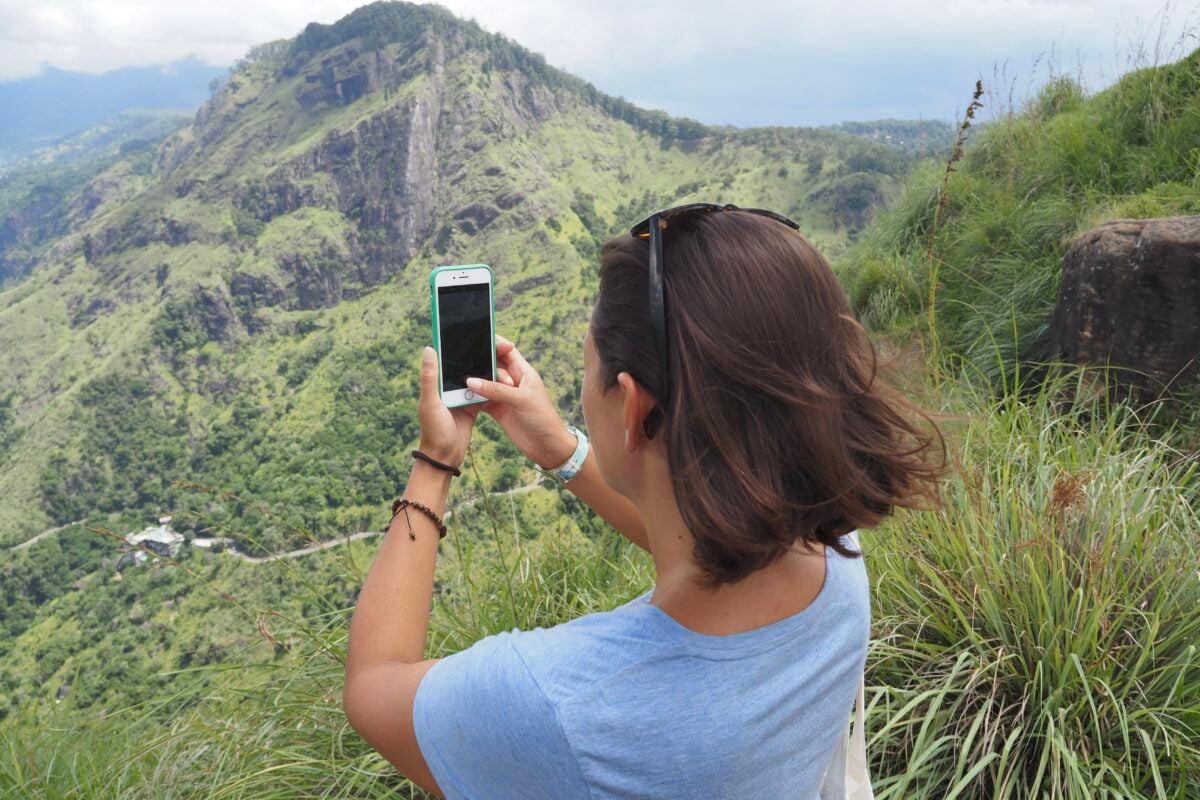
It’s a simple fact that smartphones have changed the way we travel. Whether you’re a self-confessed phone addict or prefer to have a break from devices when travelling, there’s no denying that a reliable internet connection can come in very useful on the road.
Lost? Google Maps to the rescue! Need a bed for the night? Book one last minute online from the convenience of your bus/train/boat journey. Plus, there’s the fact that you can easily stay in touch with friends and family back home!
If you’re feeling bamboozled about the best way of staying connected (without spending a fortune), we’re here to help! Read on to find out all there is to know about SIM cards for travel.
Related: (opens in new tab)
How to Stay Connected On the Road: The Best Travel SIM Cards 📳
Disclosure: Some links on this page are affiliate links. We always write our articles before checking if affiliate links are available.
Long gone are the travel days of looking for an internet cafe, paying to use a computer and waiting for the dial-up connection before you could use the web. (Maybe I’m showing my age here!) Today, instant connectivity is available (almost) anywhere, and it’s no surprise most travellers want online access wherever they roam.
When it comes to internet access while travelling, there are essentially four main options:
- Your existing SIM card
- eSIM cards
- Local SIM cards
- International SIM cards
Using Your Existing SIM Card 📶
Some mobile networks have packages that include an allowance for international roaming. This usually won’t be included in a basic plan, but if you have a premium plan it may well be. It’s worth checking what’s included in your existing package before looking elsewhere.
Alternatively, some providers have the option to add on monthly extras, such as data to use in other countries. If you’re travelling for a month or two, this may be a convenient option, but it’s unlikely to be the most cost-effective. If you’re travelling long term (3+ months), you’re probably better off with one of the below options.

eSIM Cards 📧
An eSIM (or embedded SIM) is a virtual SIM card. Newer models of several major phone brands now have the functionality to use eSIMs, and they are a huge boon for travellers!
Most eSIM-enabled phones still have a slot for a physical SIM card (although the US version of iPhones, at least, do not). This means that travellers can keep their physical home SIM card in their phone as normal and purchase an eSIM card for travel. (The other option of course is to use the eSIM function for your home number and leave the space to insert a local physical SIM card.)
With both the eSIM and a regular SIM activated in your phone, you can switch effortlessly between numbers, depending on your requirements and location. At the moment, not all phones or carriers support eSIMs, but it’s worth checking if it is possible for yours to do so.
Mobile Data Settings: Reminder! 📴
If you’re using two SIMs don’t forget to adjust your phone settings so that it’s using Mobile Data on your travel SIM and not your home SIM, otherwise you’re in for a nasty surprise when you get your bill.
There are an ever-increasing number of travel eSIM providers, but a few of the most popular are Airalo, Holafly, Saily, Jetpac, AloSIM and Nomad. eSIMs are probably the most convenient way to stay connected, but they are also the most expensive. You can buy a plan and install an eSIM from anywhere in the world, so that as soon as you land at your destination and switch on your phone — voilà, it connects and you’re online immediately!
Another advantage of eSIMs for travel is that some providers offer regional SIMs. This means you can purchase one eSIM card that will work across multiple countries, saving you the hassle of having to buy a new one each time you cross a border.
Best eSIM Providers for Travellers – Quick Answers!
👉 To learn more, read our guide to the best eSIMs for travel here.
Local SIM Cards 📲
Buying a local SIM card when you arrive in a new country is the cheapest option wherever you’re travelling in Southeast Asia. The only downside is that it’s also the least convenient — but that’s not to say it’s difficult!
Almost every major carrier across Southeast Asia offers tourist-specific SIM cards. These are tailor-made for travellers and often come with large data allowances but very few (or even no) minutes and texts, making them cost-effective for internet access.
Check for Time Limits ⏳
Be aware that tourist SIMs usually expire after a set period. (The longest is often 30 days.) Sometimes you can keep them active by topping up before the expiry date, but not all providers allow this. Make sure you look for this information before making a purchase.
You’ll see local SIMs for sale at most airports in the region. Buying one of these is of course the quickest way to get online once you’ve landed. However, if you want more bang for your buck, we’d advise that you hold off and purchase one in the nearby town or village. You’ll almost certainly get a better deal, which means more data for less money. Unless you’re heading somewhere very remote, even the smallest islands and destinations usually have somewhere to purchase local SIMs.
The process only takes a few minutes and involves registering your new SIM to your name (you’ll need your passport!). But don’t worry, the helpful sellers will usually take care of everything for you. All you need to do is choose how much data you want (10GB, 20GB, 100GB etc.) and for how long you’ll need the SIM active (e.g. 10 days, 14 days, 30 days). Oh — and try not to lose your home SIM card once your new one is in place in your phone (not that I’ve ever done that…).
You can buy SIM cards either from official stores or small shops/stalls that are not affiliated with the main carrier. You’ll likely find better deals at the official store. However, local SIMs in Southeast Asia are very cheap, so paying a little more at a roadside shack isn’t going to break the bank. I’ve done this several times without any issues and always had good service (from the sellers and my phone!).
Cost of Local SIM Cards 💰
The cost of local SIM cards vary from country to country, and, as with all things, prices can change regularly. As a rough guide, you should be able to pick up a local SIM valid for 30 days with a decent amount of data for around $10 USD. Note that is this an average, and in some countries they may cost far less (e.g. Laos) or far more (e.g. Singapore).
Best Local SIM Cards in Southeast Asia – Quick Answers!
To find out more about the mobile carriers in each country in Southeast Asia, click on the country guides below!
- Brunei SIM Card Guide Quick Answer – Progesif Tourist SIM
- Cambodia SIM Card Guide Quick Answer – Cellcard Tourist SIM
- East Timor SIM Card Guide Quick Answer – Telemor
- Indonesia SIM Card Guide Quick Answer – Telkomsel
- Laos SIM Card Guide Quick Answer – Unitel
- Malaysia SIM Card Guide (Quick Answer – Celcom SIM
- Myanmar SIM Card Guide Quick Answer – Ooredoo
- The Philippines SIM Card Guide Quick Answer – Smart
- Singapore SIM Card Guide Quick Answer – Starhub Tourist SIM
- Thailand SIM Card Guide Quick Answer – AIS
- Vietnam SIM Card Guide Quick Answer – Viettel

International SIM Cards 🌏
Before eSIMs took off, international SIM cards were a popular option. They are physical SIMs that allow you to connect to the web, wherever you are, without having to worry about picking up a local SIM.
They may be a good option if you don’t have an eSIM-enabled phone but still want the convenience of getting online as soon as you land in a new country. They are significantly more expensive than local SIMs, but for some travellers, the ease of use and peace of mind is worth the extra cost.
Dual SIM Phones ✌️
Dual-SIM phones are those with the ability to hold and use two physical SIM cards at the same time. They aren’t very common, but if you happen to have one this functionality is useful when travelling. It will allow you to use both your regular physical SIM and a local SIM or international SIM at the same time. There are also some countries where it is recommended to have two local SIMs if you will be travelling around a lot, as some carriers provide an amazing connection in one part of the country but next to no signal in other areas.
Unlike national carriers, international SIM companies do not have their own cell network in place. Instead, they piggyback off of local carriers to provide the strongest signal to their customers across the globe.
Most of the time, international SIM companies work with the biggest networks in each country so they can offer the most coverage. Sometimes, they will work with two or three carriers per country to ensure the highest quality service.
Best International SIM Cards:
- Where to Get a SIM: From their website.
- Cost: $35USD – $40USD
- Where to Top Up: On their website.
- Number of Countries the SIM Works In: 200+ with their expedition package, 170 for data. The regular international SIM works in 200+ with 4G data working in 50.
OneSIM has been operational for over 25 years, making it one of the longest-running international SIM card companies. Each SIM comes with two numbers, one US and one European, with the option of adding more numbers for a cost of between $10 and $200USD depending on which country you want the number to be from. These extra numbers do not last forever and have a subscription cost attached to them. Each one is different, so check the website carefully before making your purchase.
- Where to Get a SIM: Available on their website.
- Cost: The SIM is free, but you are required to top up and pay delivery fees upon ordering.
- Where to Top Up: Add credit on the website.
- Number of Countries the SIM Works In: Up to 200 countries depending on the SIM you choose.
World SIMs come with UK and US numbers, and you can add virtual numbers from up to 50 countries. Whilst travelling, you can forward calls from your normal number to the virtual SIM, meaning taking calls from home costs far less than if you were using a local SIM! There is also a data-only SIM that works in over 180 countries.
Travel SIM Cards FAQs 🤔
What’s the cheapest option for travel SIM cards?
When it comes to SIM cards for travel, the most budget-friendly option is buying local SIMs. You’ll need to purchase a new SIM card each time you cross a border. Yes, it’s less convenient compared to buying an eSIM, but there are significant savings to be made!
What’s the most convenient way to stay connected in Southeast Asia?
If you’re looking for ease, then travel eSIMs are the most convenient way to stay connected on your travels. You can even buy and set up the eSIM before leaving home so that you have instant access when you arrive. If you need to renew or top up, it’s as simple as tapping a few buttons — very useful when you’re on the road!
Is buying a local SIM card a hassle?
Not really. Sure, it takes a little time out of your day, and you won’t have internet access the moment you enter the country, but what’s a few hours offline and a few minutes registering a local SIM? Even if it takes a bit of effort, navigating things like this is part of the adventure of travel!
Is it easy to find local SIM cards in Southeast Asia?
Yes! You can pick up local SIMs at airports all over the region! For better deals, wait until you get to your destination — SIM cards are sold in local shops, convenience stores and at roadside stalls almost everywhere in Southeast Asia.

Lisa Barham
Having always dreamt of travelling the world, Lisa finally decided to follow that dream in her mid-thirties when she left her nine-to-five in London for life on the road. After trekking to Everest Base Camp in Nepal and learning to surf in Sri Lanka, she headed for wondrous Southeast Asia, where she can currently be found solo backpacking, navigating through life and unfamiliar streets.
Follow her on: Instagram